You might be wondering whether an actually stylish, functional kitchen is even possible inside a standard Dhaka apartment or a compact home in Chattogram… plus, about 73% of urban Bangladeshi households deal with kitchens that scarcely exceed 80 square feet.
Putting that aside for now, the worry about overspending is real too. Premium, modular setups can climb past BDT 12 lakh.
That feels out of reach for a bunch of. Kitchen interior design in Bangladesh has shifted noticeably over (as one might expect) the past couple of years. You don’t need a sprawling floorplan or a bottomless bank account to make it work.
The short version
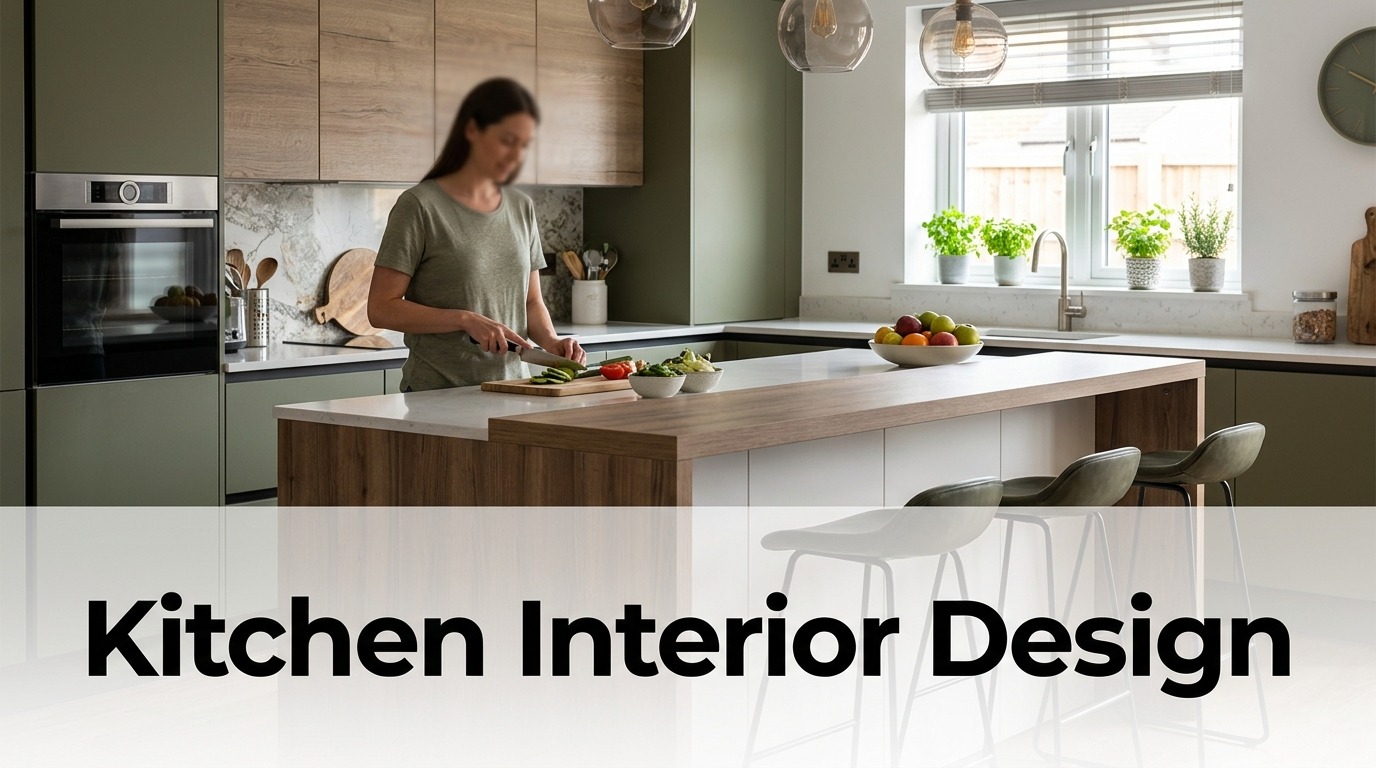
- Warm minimalism is the standout direction for 2026, trading cold whites for terracotta, beige, and muted greens that feel rooted and inviting.
- A compact work triangle (120–180 cm sides) plus at least 60 cm of landing space beside the cooktop can dramatically speed up daily cooking.
- Modular kitchen costs in Bangladesh range from BDT 2,00,000 to BDT 12,00,000 depending on size and materials, so even a mid-range plan around BDT 5,00,000 can deliver solid returns.
Main points
- You can absolutely avoid that cramped feeling; strategic vertical storage and foldable surfaces are being used in Mirpur and Gulshan apartments right now.
- The single biggest upgrade most families overlook is a chimney rated for at least 900 CFM; without it, even a beautiful kitchen turns sticky and greasy fast.
- Material choices like natural wood finishes and low-VOC boards do double duty: they look grounded and they genuinely improve indoor air quality in compact spaces.
Table of Contents
- What Exactly Is Kitchen Interior Design in Bangladesh?
- How Smart Layouts Solve Space and Workflow
- Why Materials and Colors Make or Break a Kitchen
- Smart Kitchen Technology on a Realistic Budget
- People Also Ask
What Exactly Is Kitchen Interior Design in Bangladesh?
Kitchen interior design in Bangladesh is the planned arrangement of cabinetry, work surfaces, appliances, lighting, and finishes built for the climatically humid, often compact, and budget-sensitive homes found across the country, it’s about making a small, hardworking room feel breathable, efficient, and personally yours, not just about looking good in a photo.
In practice, that means thinking beyond basic tile and granite; here, designers blend local realities, like frequent load-shedding and high humidity, with globally influenced trends. It’s worth noting that it’s less about copying a magazine layout, and more about solving real problems: where do you keep a 20-kg rice sack? How do you stop mold from creeping into cabinets, and can you actually- okay. More accurately, afford quality plywood that (which is a critical factor) won’t warp after two monsoons?
When I first started working with families in established Dhaka. Now, I quickly learned that a glossy European catalog layout fails here. From what we can tell now. That’s why a chimney with at least 900 CFM capacity points to up in almost every successful project I’ve seen.
That jumped out at me too. Which means without it, even a BDT 8 lakh kitchen can feel unlivable after a month (which is a critical factor) of bhuna cooking.
How does that play out? The renewed focus, as the Archiseum Design Team describes it, is where does that leave us? You can decide. Is on “warm minimalism” that replaces stark white kitchens with earthy tones like terracotta. Beige (which aligns with standard practices) and muted greens in 2026.
As it turns out, puts things in perspective, but that shift isn’t just aesthetic.
Matte finishes and those soothing palettes also hide the fine scratches and dust that are nearly. Let me put it differently: impossible to avoid in a busy Bangladeshi household, a practical win that rarely gets mentioned (and the data generally agrees) in glossy blogs.
How Smart Layouts Solve Space and Workflow
An L-shaped layout works for most apartments because it keeps the work triangle tight, while single-wall kitchens suit tiny one-room setups where every inch of countertop doubles as the dining area, and if you’ve more than four family members, a U-shaped or island-focused plan will likely save you from constant collisions during meal prep.
Layout isn’t just about shape. It’s about the numbers you don’t see. What this means is the work triangle, the invisible line between your sink and stove.
In most scenarios, the fridge should measure between 120 and 180 cm on each side. Any tighter and you’re bumping elbows constantly.
What matters even more, any wider, and you’re worn out just by moving around.
At least 60 cm beside the cooktop gives you room to set down a hot pot without knocking over the spice box. For all intents and purposes. Another 40 to 60 cm next to the sink means you can drain a colander of rice (which completely makes sense logically) without a balancing act.
When I visited a two-bedroom flat in Uttara recently. The original kitchen was a straight corridor with (which aligns with standard (at least in many practical scenarios) practices) scarcely any prep zone. We converted it into an L-shape by knocking out a non-load-bearing wall. Kept the total cost under BDT 3,50,000.
That changes the picture quite a bit, and added a folded wall-mounted breakfast table that disappeared. When not in use. Lately, that one change reclaimed about 14 square feet of floor space.
Here’s how common layouts compare in a Bangladeshi context:
| Layout | Best for | Typical Cost Range (BDT) | Who It Helps |
|---|---|---|---|
| Single-wall | Studio flats, couple-only homes | 1,80,000 – 3,00,000 | Minimal movement, easy to clean |
| L-shaped | 2–3 person apartments, open plan | 2,50,000 – 5,50,000 | Unobstructed triangle, corner storage |
| U-shaped | Large families, frequent batch cooking | 4,50,000 – 9,00,000 | Lots of counter space but more walking |
| Island-focused | Open kitchen-dining combos | 7,00,000 – 12,00,000 | Great for entertaining, requires 3 ft clearance |
How does the work triangle actually work in a small kitchen?
You keep the three main work points within a compact loop. 120 to 180 cm per side, and you never place a tall fridge. Or a full-height pantry in the (depending entirely on the context) middle of that path.
At this point, you’ll notice many Dhaka kitchens I’ve seen ignore the triangle entirely, and the result is a cluttered counter sprawl with dishes piling up on the floor.
Why Materials and Colors Make or Break a Kitchen
Using light, matte colors with warm wood accents isn’t a passing fad; it directly reduces the visual weight of a small space and hides the kind of everyday wear that glossy surfaces boost, and specifying E1 or CARB-compliant boards means you and your family breathe fewer formaldehyde fumes, especially in a kitchen where you may stand for two hours at a stretch.
” But after six months, the (which completely makes sense logically) regret sets in, and honestly. Curry stains, turmeric smudges, and the constant battle with water spots turn that white into a maintenance nightmare. That’s where warm minimalism steps in: beige walls. Terracotta backsplash accents, and cabinet fronts in a soft wood finish. Finger (at least in loads of practical scenarios) smudges practically disappear.
Beyond the surface, what’s inside the board matters. E1 or CARB-compliant plywood may add about 15–20% to your cabinet cost.
Worth pausing on that one, but it releases lower formaldehyde levels. (which works out well in practice) Enclosed space, think of a kitchen with the windows shut (more on that later) during a sudden nor’wester.
That can keep dizziness, and eye (which works out well in practice) irritation at bay. Unusual, but true.
Sustainability is no longer a buzzword here either, and bamboo shelving and reclaimed wood accents are showing up more, though availability in places outside Dhaka can be patchy. In reality, Style Archi experts stress that “sustainability, well, actually, is a pickup in kitchen design in Bangladesh. Powered by environmental awareness,”.
It’s a lot to process, I’ve found. Scratch that: even small touches, like a bamboo cutlery tray. Or a reclaimed wood open shelf, give a kitchen a grounded, lived-in character that (more on that later) feels unmistakably local. Keep this in mind; it shows up again soon.
When the kitchen opens into a living area, the wall colors, which means the decor of the adjoining living room, start to matter just as much. I’ve found that large wall decor solutions, like a textured accent wall or a (though exceptions exist, naturally) single oversized piece. Can visually anchor the entire open plan.
The kitchen doesn’t feel like an afterthought. You can carry that cohesive look across the border by aligning the cabinet tones with the living room’s dominant color scheme.
What’s the most durable countertop for a Bangladeshi kitchen?
Granite remains the workhorse mainly because it handles hot pans and acidic marinades without staining easily, and but quartz composites are slowly gaining ground among families who want (which is a critical factor) zero sealing maintenance. The catch is cost: decent granite runs about BDT 1,200–2,500 per square foot. While quartz can start (at least based on (which works out well in practice) current observations) at BDT 2,800.
That’s a big gap, both will outlast laminate, which tends to bubble near the sink after two monsoons. It ties everything together later.
Smart Kitchen Technology on a Realistic Budget
You don’t need a fully automated showroom; a few targeted smart additions- a water purifier with TDS monitoring, app-controlled LED strips, and a single smart oven- can cut utility wastage and actually make cooking less chaotic, as long as your building’s electricals can handle the load.
The reality check, of course. Is that a lot of older buildings in Bangladesh have wiring that wasn’t once meant for continuous high-draw appliances; a smart oven that preheats via your phone sounds brilliant until the circuit trips midway. That doesn’t mean skip technology completely.
It means be selective.
In a project I supervised in Mohammadpur, so on average, now, those two additions, paired with a standard chimney. A notable detail & gave the kitchen a noticeably more modern feel without straining the circuit.
Now, on average no more harsh overhead tube lights casting shadows on the chopping board.
Looking at this from another angle. Another quiet revolution is happening in cabinetry. Integrated USB charging stations tucked inside a drawer. In most cases, where someone always needs to top up a phone. Or a tablet while watching a recipe video. What happens when you do?
That tiny upgrade costs less than BDT 3,000, so if you plan for it during the wiring phase.
If you’re deep into researching suppliers, this roundup of top interior design websites in Bangladesh includes platforms where you can compare appliance specs and even order samples online, which can save a couple of damp trips to a market on a rainy afternoon. You’ll see why it matters in a bit.
Is a smart kitchen worth the extra cost in Bangladesh?
Sure enough, ” A remote-controlled chimney, and a water purifier that alerts you. When the filter needs changing? You get the idea. Totally worth it, mainly because they fix real hygiene and convenience problems, but a full IoT refrigerator that syncs with your grocery app? That’s still a novelty in most Bangladeshi homes, and the frequent power cuts can corrupt the software unless you’ve a stabilizer and a strong UPS backup.
People Also Ask
How much does a mid-range kitchen interior design in Bangladesh cost?
A mid-range kitchen in Bangladesh, with laminate cabinets, a modest chimney, and granite countertops. It just works. Usually falls between BDT 3,50,000 and BDT 6,00,000. That jumped out at me too. The budget covers a functional L-shaped.
Or a U-shaped setup in an average-sized apartment. Though the final figure jumps quickly if you add imported quartz or smart appliances.
Can I design a modern kitchen for under BDT 2,00,000?
Yes, but you’ll need to make smart trade-offs: choose locally. Scratch-fabricated plywood cabinets with a melamine finish, install a single-wall layout. Use a ceramic cooktop instead of a built-in hob, and skip the chimney in favor of a powerful exhaust fan if the ventilation is enough (though exceptions exist, naturally). Most likely it’s not luxurious might be true. But it’s neat and functional for 5–7 years.
What is the best chimney capacity for Bangladeshi cooking?
A rating of at least 900 CFM (cubic feet per minute) is recommended for kitchens. Where heavy frying and spice tempering are daily occurrences. A sticky residue on cabinets and walls- that’s what happens, and when anything lower. Say 600 CFM, will struggle to pull smoke and oil particles rapidly enough.
Are open shelves a good idea in a Dhaka kitchen?
Open shelves look airy and let you display ceramic jars. But in Dhaka’s dust-prone air, they demand constant wiping. A striking point, if you love the look, limit open shelving to upper wall areas and use closed cabinets below the counter.
That way, you grab the visual lightness without turning (more on that later) daily cleaning into a chore.
How can I make a small kitchen look bigger without tearing down walls?
Going back to what was covered earlier, light matte wall paint. Mirrored backsplash panels in strategic spots; under-cabinet LED strips. And slab-style cabinet fronts without heavy molding all create an illusion of more space. From a broader view, replacing solid upper cabinet doors with ribbed glass inserts can open up the room visually.
Here’s the thing – living with a kitchen that finally matches how your family actually cooks. Instead of fighting against it. Is the kind of upgrade that pays back in calmer mornings and easier evenings, and starts with the measurements, selects a palette that forgives the daily chaos, and honestly, gives the chimney the priority it deserves.