
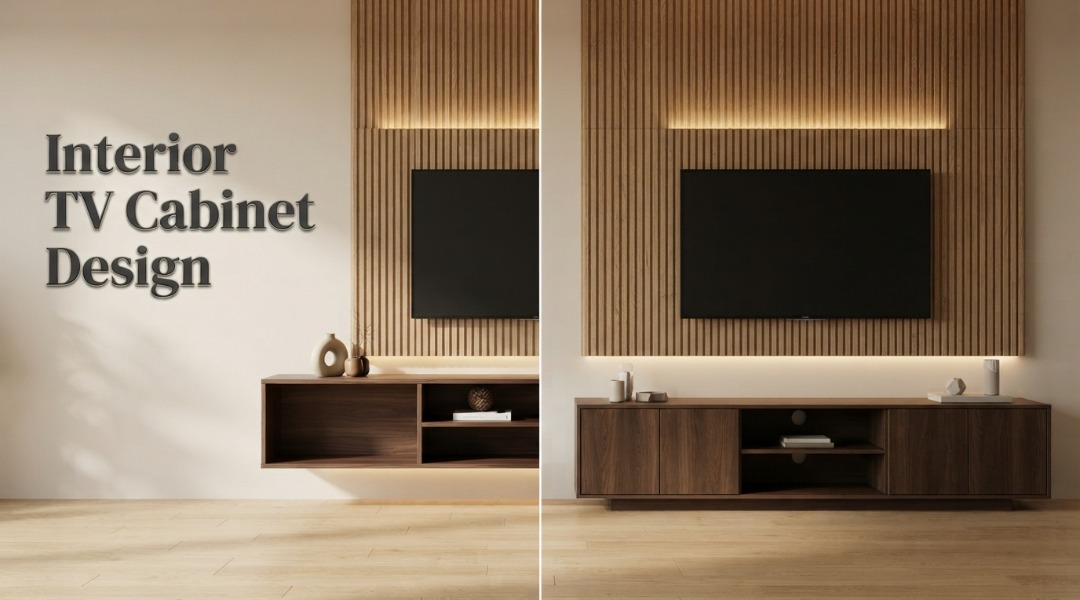
Choosing the right interior TV cabinet design decides whether your living room feels balanced or completely overwhelmed by electronics. Homeowners constantly debate between mounting a floating TV console directly onto the wall or anchoring the room with a freestanding floor-standing cabinet.
Pick the wrong option, and you risk bowing wall surfaces or wasting half your storage space on an oversized furniture piece. Trend roundups from 2026 show strong demand for floating consoles, fluted or slatted panels, warm lighting, and mixed-material finishes such as wood, stone, and metal. The battle comes down to visual lightness versus heavy-duty storage capability, and both options serve very different household routines.
- Floating TV units keep floors clear and make small rooms look bigger, but require solid wall anchoring and limit storage depth.
- Floor-standing cabinets handle heavy equipment up to 100 pounds with zero drilling, yet take up noticeable floor space.
- Pick floating models for compact minimalist layouts and floor cabinets for maximum media gear storage.
Key Point
- Wall strength dictates your choice: hollow plasterboard will fail under loaded floating units without timber studs, whereas concrete block holds easily.
- Storage volume differs drastically between styles; deep receivers rarely fit inside slim hanging shelves.
- Floor cabinets provide instant access to cables, but floating designs make daily floor sweeping effortless.
Table of Contents
- Floating vs Floor-Standing Interior TV Cabinet Design at a Glance
- Contender Profiles: Floating Units vs Floor Cabinets
- Head-to-Head Testing: Three Core Media Unit Demands
- Which TV Cabinet Design Should You Choose?
- People Also Ask
Floating vs Floor-Standing Interior TV Cabinet Design at a Glance
Floating TV units increase floor openness and contemporary aesthetics, while floor-standing cabinets offer superior load capacity and deeper storage without structural wall modification. Floating models suspend your media gear above the ground for an airy look. Floor-standing designs sit firmly on the deck, supporting heavy subwoofers, massive sound systems, and family keepsakes.
Here is how both contenders match up across key living room requirements:
| Design Attribute | Floating Wall Console | Floor-Standing Media Cabinet |
|---|---|---|
| Floor Footprint | Zero floor space occupied (fully suspended) | Takes 16 to 24 inches of floor depth |
| Typical Weight Limit | 40 to 70 lbs (depends on anchors) | 100+ lbs with ease |
| Storage Depth | 10 to 14 inches (slimmer profile) | 16 to 22 inches (deep storage) |
| Installation Effort | High (stud finder, heavy drilling, levelling) | Low (assemble and set in place) |
| Cleaning Convenience | Excellent (vacuums slide right under) | Moderate (dust builds behind and beneath) |
| Room Relocation | Hard (requires patching and repainting) | Easy (slide to a new wall anytime) |
| Visual Impact | Sleek, weightless, modern architectural line | Grounded, classic, substantial presence |
USABLE STORAGE VOLUME COMPARISON (LITERS)
Contender Profiles: Floating Units vs Floor Cabinets
Floating TV units prioritize visual minimalism by cantilevering storage off your wall, whereas floor-standing cabinets rely on self-supporting joinery that handles substantial items without wall stress. Understanding how each unit functions structurally helps you select the right fit for your room size, wall construction, and lifestyle.
What Is a Floating TV Unit?
A floating console is a wall-hung storage cabinet that mounts flush against your wall surface without legs or ground supports. It uses heavy-duty French cleats or steel wall anchors driven directly into structural studs or masonry. Because it hangs 8 to 12 inches off your flooring, it creates an uninterrupted floor line that tricks the brain into seeing a larger room.
Its greatest strength is modern styling. You get integrated wire channels that run behind the cabinetry directly into wall conduits. But it comes with real limitations.
It gives up deep cabinet depth, usually capping internal shelves at around 12 inches. If you live in an apartment with thin drywall partitions, poor installation can pull the unit straight out of the wall.
What Is a Floor-Standing TV Cabinet?
A floor-standing media unit is a freestanding furniture piece that rests directly on legs, a plinth, or a recessed base. It acts as an anchor for the entertainment zone, providing deep drawers, side cupboards, and wide shelves that hold bulky AV components. Retail models easily support televisions up to 70 inches and bear upwards of 100 pounds without testing your drywall fasteners.
This format excels at heavy storage. You can stash gaming consoles, heavy amplifiers, board games, and power banks behind clean timber doors. The downside involves physical presence. In tight living rooms common in Dhaka or urban apartments, a 20-inch-deep cabinet eats up precious walking space and turns the floor around it into a dust trap.
Head-to-Head Testing: Three Core Media Unit Demands
Floor-standing units win outright on raw capacity and equipment flexibility, but floating cabinets dominate in spatial openness and cable concealment. Deciding between them requires comparing how each option handles storage demands, device ventilation, and overall room balance.
Round #1: Storage Capacity and Weight Support
When you pile on sound bars, game consoles, and books, weight adds up fast. Most floating consoles support between 50 and 70 pounds safely when anchored properly. Try loading them with heavy vinyl collections or multi-channel receivers, and you will notice shelf deflection over time. Users appreciate adjustable shelves because they make the same cabinet work for games, books, and devices, yet floating designs rarely offer more than two short tiers.
Floor-standing units easily carry 100 pounds or more on top, with internal compartments taking another 80 pounds. Their deep internal bays swallow full-sized PlayStation 5 consoles, streaming receivers, and albums without door resistance. When exploring modern living room TV units, homeowners with serious gear collections consistently discover that floor designs deliver superior utility.
Round Winner: Floor-Standing TV Cabinet for undisputed weight limits and cubic storage volume.
Round #2: Cable Management and Device Ventilation
Cords make or break any media setup. Floating consoles shine at cord hiding because designers build them with hollow back cavities and integrated wire brushes. You drop your HDMI and power lines straight down through internal raceways into wall plates.
The wires simply vanish. However, heat can accumulate in narrow floating chambers if you fail to specify ventilation slots behind high-draw consoles.
Floor-standing consoles feature standard rear cutouts, but cords as expected drop down behind the legs. Unless you spend an afternoon wrapping cables in sleeves, that rat’s nest shows against baseboards. In regions with dusty dry seasons or high indoor humidity, sweeping beneath floor units becomes a hassle. Floating designs allow automated robot vacuums and manual mops to pass underneath freely.
Round Winner: Floating TV Unit for cleaner cable concealment and superior room hygiene.
Round #3: Spatial Balance and Wall Safety
Retail guidelines point out that TV cabinets should be at least as wide as the TV, or slightly wider, for balance and fit. A 65-inch screen spans roughly 57 inches wide. Pairing that with a 50-inch cabinet looks awkward and top-heavy. When decorating large living room walls, a long floating console provides a continuous horizontal line that anchors the wall without crowding it.
Installation safety, however, shifts the balance. In concrete or solid brick homes across South Asia, mounting a floating console using nylon expansion plugs is direct. But if you mount on modern gypsum partitions, you must find solid studs. If someone accidentally sits on the edge of a floating unit, it can rip away from the plaster.
Floor-standing cabinets carry zero structural risk, making them safer for homes with toddlers.
Round Winner: Floating TV Unit for aesthetic proportion, though tied closely with floor units on structural peace of mind.
Which TV Cabinet Design Should You Choose?
Choose a floating TV unit if you live in a modern apartment under 1,400 square feet and prefer a clutter-free look, but choose a floor-standing cabinet if you own extensive media hardware or rent your home. The correct decision balances room square footage, wall materials, and your long-term storage requirements.
Specifically choices while balancing cost and long-term value, weigh your living arrangements honestly:
- Choose a floating console if your living room has concrete or solid brick walls, your floor area is under 180 square feet, and you use streaming sticks instead of multiple gaming consoles.
- Choose a floating console if you want your robot vacuum to clean the entire floor without bumping wooden table legs every single morning.
- Choose a floor-standing cabinet if you are renting and want to avoid drilling anchor holes into your landlord’s walls.
- Choose a floor-standing cabinet if you need deep storage for heavy stereo equipment, subwoofers, board games, and dense photo albums.
For homeowners working on budget-friendly home renovations in Dhaka, local joiners can build either style using moisture-resistant commercial plywood and laminate finishes. Ready-made floor units typically save around 20% to 30% on initial setup since they eliminate specialized wall mounting labor.
- Measure TV screen width, Calculate total width and select a cabinet that measures at least 6 to 10 inches wider than the outer edges of the display.
- Inspect wall construction, Tap the wall surface to determine if you have solid brick masonry or lightweight drywall over studs.
- Inventory media equipment, Count your consoles, soundbars, and routers to confirm whether a 12-inch floating depth fits your largest component.
- Map outlet positions, Verify that wall sockets sit directly behind the planned cabinet body so wires remain fully concealed from view.
People Also Ask
What is the ideal width for an interior TV cabinet design?
Your TV cabinet should always be at least as wide as the television screen, or roughly 4 to 8 inches wider on each side. A wider base prevents the screen from looking top-heavy and protects the display from being bumped by passing foot traffic.
Can a drywall safely support a floating media console?
Standard hollow drywall cannot safely hold a floating media console on its own. You must secure the mounting brackets directly into wall studs or solid masonry brick. For drywall partitions, reinforcing the frame with solid timber backing prevents costly wall failures.
Which cabinet design makes compact living rooms feel larger?
Floating TV consoles make compact living rooms feel noticeably bigger because they keep the floor line visible. Exposing 10 to 12 inches of open floor beneath the furniture tricks the human eye into perceiving greater overall floor area.
How do closed doors compare to open shelving for media gear?
Enclosed cabinet doors hide tangled wires, power boards, and gaming clutter to give the room an orderly look. Open shelving provides immediate airflow for hot gaming consoles and allows remote control signals to reach media boxes without opening panels.